


The Best Antifreeze for Your Car
Coolant is the only fluid in the car that works all year round, with the engine hot or cold, and that almost nobody checks until the temperature gauge starts to climb. This guide explains what it is, the types available, when to change it and how to do it at home.
What coolant is
It's the mixture that circulates between the engine and the radiator to carry heat away from combustion and release it into the air. It contains water, a glycol-based antifreeze and a package of anti-corrosion additives. Without it, the engine overheats in minutes. Even in the depths of winter, because a running engine generates heat regardless of the temperature outside.
The system is sealed and pressurised. Never open the radiator cap with the engine hot: the fluid is above 100 °C without boiling, because of the pressure, and sudden decompression sprays it out.
Coolant or antifreeze? The difference almost nobody explains
In everyday use the two names are treated as synonyms and, once diluted, they're practically the same thing. But technically they aren't the same product.
- Antifreeze is the concentrate. Pure or almost pure glycol, sold in a bottle, without water mixed in yet.
- Coolant is what runs inside the car. Antifreeze already diluted with water, usually in a 50/50 ratio, ready to use.
The confusion matters in one specific situation. If you buy a concentrate and pour it neat into the radiator without diluting it, you don't get more protection. You get a worse fluid, less able to transfer heat.
What it does
It helps to think of coolant as three products in one.
- Temperature control. It absorbs heat from the engine and releases it in the radiator. Water alone already does this; it's the rest of the system that can't survive on water alone.
- Freeze protection. Glycol lowers the freezing point. Pure water freezes at 0 °C and, as it expands, can crack the engine block.
- Corrosion and scale protection. The additive package protects aluminium, steel and rubber, and prevents scale building up inside the engine's passages.
It's this third job that most people ignore, and it's what ruins cooling systems in mild climates, where it rarely freezes.
Why you can't use tap water
In mild climates it rarely gets down to -25 °C, and the temptation to use plain water is common. It doesn't work, for three reasons.
- It contains minerals which, with the heat and pressure of the system, form scale on the inner walls of the radiator and engine, reducing heat transfer.
- It has no corrosion inhibitors. Aluminium and iron in direct contact corrode faster, and also cause galvanic corrosion between them.
- It boils at 100 °C. Glycol raises the boiling point, which matters in stationary traffic, in summer, with the air con on.
If you need to top up the level on the way home, use distilled water, never tap water, and replace it with the correct mixture as soon as you can.
Types of antifreeze: G11, G12, G12+, G12++ and G13
The codes G11 to G13 come from the German VW TL 774 standard and have become standard industry vocabulary, even outside VAG cars. They don't describe the colour: they describe the base chemistry.
G11, IAT technology
The oldest generation, formulated with silicates and phosphates. It protects well, but the additives run out quickly: it's changed roughly every 2 years. It's the technology of older cars. Typical colour: blue or green.
G12 / G12+ / G12++, OAT and hybrid technology
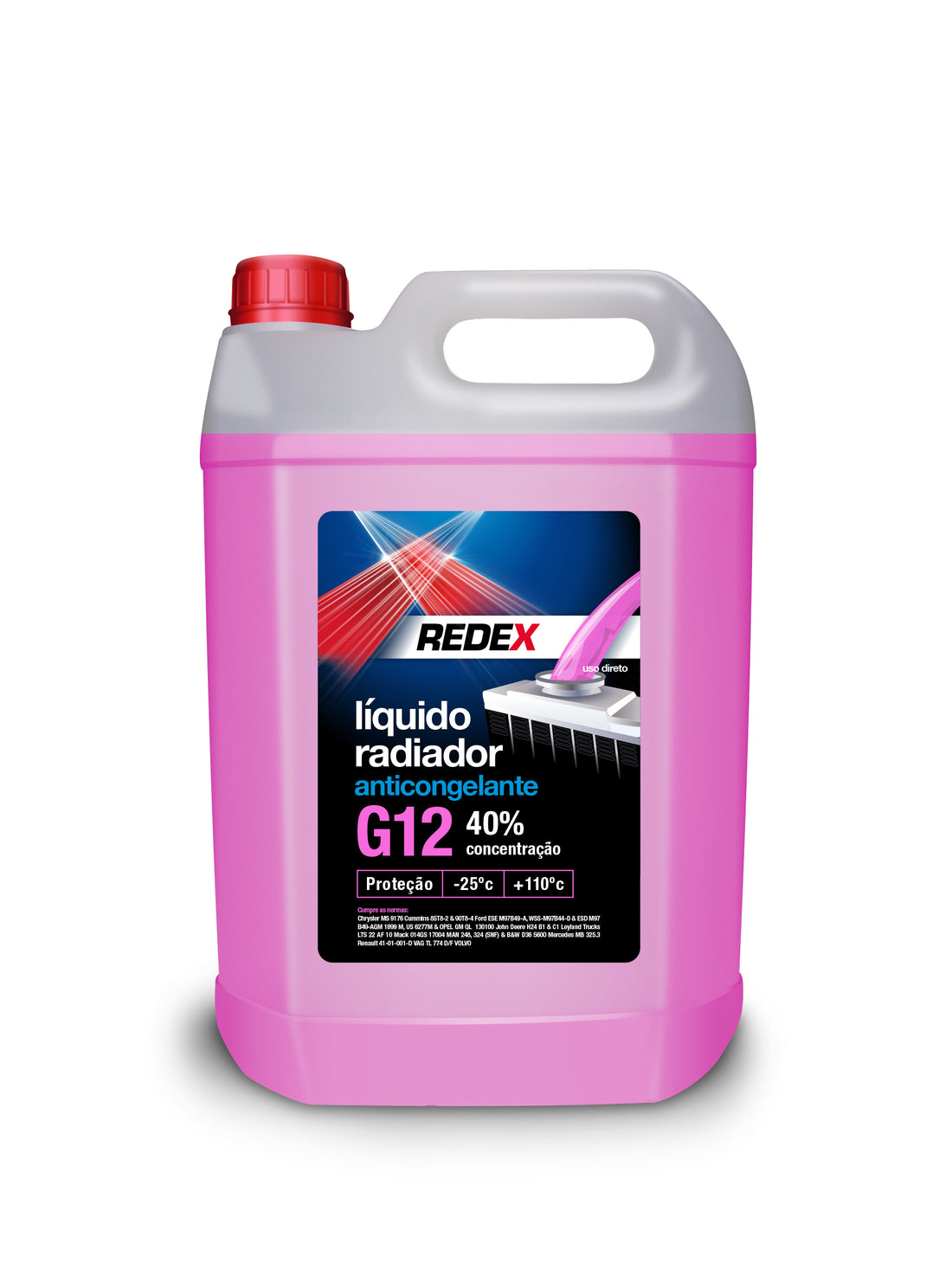
Based on organic acids, with no silicates (G12) or with a hybrid inhibitor package (G12++). It lasts longer, typically 2 to 3 years or up to around 150,000 km, and is today the most widely used family in the European car fleet. G12++ is the most versatile across brands, the default choice when you don't know exactly which one your car left the factory with. Typical colour: red or pink. Redex Antifreeze G12 uses this technology and comes ready to use at 40% concentration, with protection down to -25 °C and boiling resistance up to +110 °C; if you live somewhere with extreme cold, choose a concentrate and adjust the dilution to the temperature you need.
G13, glycerol-based OAT technology
The most recent generation. It replaces part of the ethylene glycol with glycerol, a less toxic compound. Correctly diluted, it protects down to around -35 °C and has the longest service life of the range, up to 5 years or 250,000 km. It's the factory specification on many recent VAG models. Typical colour: purple or violet. For harsher climates, Redex Antifreeze G13, formulated for down to -40 °C, gives extra margin.
Colour is not a standard
Each manufacturer chooses whatever colour it likes. There's no law or international standard saying G12 is red: you'll find pink G12, purple and violet G13, blue and green G11, depending on the brand. Deciding whether two fluids are compatible by their colour is the most expensive mistake in this job. Decide by the technical data sheet and the car manufacturer's specification.
Compatibility table between types
The most important rule in this article: never mix IAT technology (G11) with OAT technology (G12, G12+, G12++, G13). The silicates in G11 react with the organic inhibitors in G12/G13 and form a kind of sludge that blocks the radiator's narrow channels.
| Combination | Can you mix them? | Note |
|---|---|---|
| G11 + G11 | Yes | Same technology (IAT) |
| G12 + G12+ / G12++ | Yes, with caution | OAT/hybrid family; avoid mixing different brands without checking the data sheet |
| G12++ + G13 | Generally yes | Both modern OAT; check your car's manual |
| G11 + any G12/G13 | No | IAT + OAT forms sediment that blocks the system |
| Brand A + Brand B, same letter | Only after checking | The letter indicates the chemical family, not an identical formula |
If you're unsure what's already in your car, the safest option is to drain the system completely before adding a different type. Don't mix in "just a drop to top it up".
Concentration and protection temperature table
The percentage of glycol in the final mixture determines how far down it protects. More concentration isn't always better: above around 70% glycol, the freezing point starts rising again and the mixture becomes less efficient at transferring heat.
| Glycol concentration | Freeze protection | Typical use |
|---|---|---|
| ~10% | down to around -3 °C | Not enough for most climates |
| ~25% | down to around -13 °C | Below what most manufacturers recommend |
| ~33% | down to around -19 °C | Minimum dilution usually accepted |
| ~40% (ready to use) | down to around -25 °C | Formulas diluted at the factory, such as Redex G12 |
| 50% (standard mix) | down to around -37 °C | Default recommendation from most European manufacturers |
| ~60% | down to around -45 °C to -50 °C | Very cold climates; always follow the limit in the manual |
These values vary slightly with each manufacturer's formula; use them as a guide and always check the packaging. Few drivers will really need protection down to -35 °C, but the 50/50 mix isn't only about the cold: it equally protects against boiling in summer traffic and against corrosion all year round, even where it never freezes.
When to change your coolant
As a general rule, every 40,000 km or 2 years, whichever comes first, for conventional formulas (G11, G12). Long-life formulas (G12++, G13) can go up to 150,000-250,000 km or 5 years, but that's the service life of the additive, not a reason to stop checking: the level and condition should be checked every 10,000 to 20,000 km. The car's manual always has the final say; some manufacturers state "lifetime", which in practice usually means 10 years, not "never".
Signs it's time to change it
Coolant doesn't go bad overnight. The signs appear slowly.
- Cloudy or brownish colour. Healthy coolant is translucent, even when tinted. If it's opaque or has particles floating in it, the anti-corrosion additives are spent.
- A sweet smell around the engine or in the cabin, usually a sign of a small leak in a hose.
- Level dropping with no visible leak. It could be an internal leak at the head gasket: a reason to go to a garage, not a DIY job.
- Temperature gauge climbing faster than usual, especially when stuck in traffic.
If ignored, sediment builds up, corrosion advances on the radiator walls and the system loses its ability to cool, until it overheats. A head gasket blown by overheating typically costs far more than a lifetime of coolant changes.
How to check the level and condition
Visual check
Once a month, with the engine cold, look at the expansion tank (the translucent reservoir, not the radiator). The level should be between the MIN and MAX marks. Never open the radiator cap with the engine hot.
Condition of the fluid
An even, translucent colour is a good sign. Particles, visible rust or an oily look mean it needs replacing, regardless of mileage.
Test strip and hydrometer
A test strip, similar to the ones used for swimming pools, gives a quick reading of the condition of the additives. A hydrometer or refractometer measures the actual glycol concentration, which is more accurate than trusting the ratio you think you put in.
How to choose the right antifreeze
The first source is always the car's manual, or the label under the bonnet: most manufacturers state the required specification, for example VW TL 774-J or MB 325.x. After that, check the technology (IAT, OAT or hybrid) without deciding by colour, and choose a ready-mixed dilution if you prefer simplicity, or the concentrate if you want to control the ratio for your climate.
Buy the right amount for the job: Redex Antifreeze 1 L is enough to top up the level through the year, and for a full drain and refill, Redex Antifreeze 5 L saves you running out halfway through the change. The Redex range is formulated and bottled in Portugal, at the Plurifil factory in Sintra.
How to change your coolant, step by step
This is a job anyone with patience and a cold car can do at home. You don't need a lift. You need time, and to let the engine cool down fully before you start.
- Let the engine cool down completely. Several hours parked, or overnight. Never touch a hot, pressurised system.
- Find the drain plug at the bottom of the radiator (check the manual, some cars have another one on the engine block). Put a container underneath that can hold all the old fluid.
- Open the expansion tank cap before draining. It helps the fluid come out faster.
- Drain the old fluid completely. If it's very dirty, or if you're switching technology, flush the system with distilled water, let it circulate for a few minutes with the engine running and drain again before adding the new fluid.
- Close the drain plug and fill the system with the mixture in the correct ratio for your climate. 50/50 is the reference for most cases.
- Bleed the air from the circuit. This is the step most people skip. With the radiator cap open and the engine idling, trapped air rises in bubbles; keep topping up the level as it drops. Many cars have a bleed screw on a high hose: open it until fluid comes out with no bubbles.
- Turn the heater up to maximum during this process. It forces circulation and helps push out trapped air pockets.
- Check the level again the next day, with the engine cold. It's normal to need a little topping up after the first bleed.
Common mistakes
- Mixing different types "just this once". The number one cause of sediment and blockages.
- Using tap water instead of distilled. It brings in minerals that form scale.
- Not bleeding the air from the circuit. A trapped air pocket fools the temperature gauge and can cause local overheating, even with the level correct.
- Opening the system with the engine hot. A cause of serious burns.
- Relying on colour to decide compatibility. Colour is not a standard of any kind.
- Putting off the change because "it's still a good colour". The additives run out before the colour visibly changes.
Frequently Asked Questions
Can I mix coolant from different brands?
Only if they're from the same chemical family, for example two G12++ from different brands. Between IAT and OAT, no. If in doubt, drain everything and refill with a single product.
Can I use just water instead of coolant?
No, not even as a long temporary fix. It doesn't protect against corrosion or scale, and in cold climates it can freeze and crack the engine. It's only for topping up the level on the way home.
What's the real difference between G12 and G13?
Both are OAT, with no silicates, but G13 replaces part of the ethylene glycol with glycerol, a less toxic compound, and lasts longer. G12++ and G13 are today the most cross-brand compatible options.
Does the colour of the fluid tell me which type it is?
No. Colour is the manufacturer's choice, not a standard. There's pink and red G12, purple and violet G13. Always check the technical data sheet or the car's manual.
How often should I check the level?
Once a month, with the engine cold, by looking at the expansion tank.
What happens if I drive with the level low?
The engine loses its ability to cool, especially in stationary traffic. Carrying on with the gauge in the red can blow the head gasket, a far more expensive repair than changing the coolant.
Do I need to go to a garage to change my coolant?
No, it's a job you can do at home with basic tools and a cold engine. The trickiest part is bleeding the air from the circuit properly.
How much coolant does my car take?
It varies by model, usually between 5 and 10 litres for a full refill. The car's manual gives the exact capacity.
Can I use the concentrate neat, without diluting it?
It's not recommended. Above around 70% glycol, the freezing point starts rising again. Always dilute in the ratio stated by the manufacturer.


